Tuesday, April 26, 2016

Solar Power: Part 1-Introduction


Entire books are written the subject of solar setups so I will try to digest it down to the basics.  The book I would recommend for learning about setting up a solar power system is the Solar Electric Handbook. (Purchase of any of these items through our links will give us a few pennies to cover internet costs and allow us to continue providing additional content, thank you).

 Designing a solar power system can be fraught with tension and stress. There are so many terms and it seems each device uses a different nomenclature. There are watts, amps, amp hours, volts, etc. It is enough to make you think you are at the United Nations and no one has a translator.

In a series of post, I will show you how I designed my solar power system and I will detail the reasons for each item I selected. I am assuming you want a basic system that cost $5,000 or less and will provide for basic needs such as a refrigerator, LED lights, tv, fans, laptop and mobile phone charger, and other basic needs. Appliances requiring high electrical needs (heaters, large air conditioners, clothes dryers, etc) can be operated with solar but require a larger system and most likely you will need a qualified professional for the install. What I will detail is a basic system I use in my tiny house.

Let us first list the required components: solar panels, solar controller, inverter, batteries, fuses, maybe a battery charger, transfer switch and monitors, and wires to connect all together. I installed the solar controller, inverter, transfer switch and my main electrical panel in a box on the tongue of my tiny house trailer. These items are outside my home but protected from the elements. The attached photograph shows the basic components. I will detail my reasons for each item in a series of blog posts but many other items work just as well if not better.

Batteries can not be stored outside in my region because they will loose amperage in cold weather. I have four deep cycle AGM batteries installed into a cabinet that is also my lamp stand adjacent to my chair.

Your first duty is to determine: Can you afford to go solar. If all you need is one or two LED lights and charging your mobile phone, you can setup a system for $100 or so. However, operating a tiny house with more comfortable needs will cost a bit more and will depend on your needs. A basic system will cost approximately $3-4,000 dollars (assuming new components). I define a basic system as one that can power an apartment size refrigerator, tv and dvd player, laptop computer, LED lights, fans, and other basic needs.  Therefore, moving forward, we are designing a basic system as I defined above.

Wow, $4,000 dollars, that is a bit steep for a basic system-some will say. However, the cost to get electrical service in the bonnies can top well over $30,000 or more. Solar is also an investment, being off-grid frees you from the invoices of the power grid. If you are a prepper, solar will be the only power available when the grid is shutdown by unrest or other problems.

Most books and professionals will tell you first need to add up all your electrical needs to design your system. I prefer to work backwards designing my system (figure out the system I could afford and then see what it would power) because I am on a limited income. I have no choice but to do solar because the electrical grid is not available to me.

So, this is how I started. I planned for a $3500 system with all new quality components. This would be able to generate 400 watts of power from four 100 watts solar panels. This is where it get confusing; it is not complicated but can be tedious because not all items speak the same language. Your friend is the following formulas:

Watts = Amps X Voltage
or the same formula rewritten as

Amps=Watts/Voltage

I may have lost a few of you, not to worry, this will not be a math class. I will give you instructions to figure your needs. Let us assume you live up north where there is less sunshine in the winter. If you live in Texas, Florida or other areas with abundant sunshine, you will have much more power available 12 months of the year. Living up north, we get about 7 hours of usable sunshine per day in the winter (assuming blue skies or light overcast).  Remember that figure from above, 400 watts from the solar panels. Take the hours of usable sunshine per day (7) and multiply it by the 400 watts to give you the total energy generated per day in the winter from your solar panels; in this example that is 2800 watts. You will get some loss of power because of resistance of the wires and such so let us assume you are getting 2500 watts of power added to your batteries each day. Of course, in the summer you will have more sunshine but you need to design you system for the times of the year with limited sunshine. Unless you have a summer cabin that is not used in winter or some other twist; I am assuming you are designing this system for year around use.

WooHoo, now we are making progress. But wait, batteries are measured in amps or amp hours.  No worries, just convert it. 2500 watts on a 12V system is 208 amps (2500 watts/12 volts = 208 amps). So, on this one day of sunshine you have added 208 amps to your batteries (assuming the batteries needed to be charged). Wait, you can not use all that energy because your batteries should not be discharged below 50% (assuming you have lead acid batteries, not salt water batteries). Therefore, divide the 208 amps by half to get roughly 104 amps for your daily use.

Ooops, here we are again at the United Nations; most electrical items are not rated in amps, many are rated in watts. For example, a 60 watt bulb or a 37 watt refrigerator. No worries, just convert it again: 104 amps X 12 volts = 1248 watts. You have 1248 watts available for your 24 hour day; the next day more energy will be generated. Some days, you might have excess and other day, you might draw more than what is generated from the batteries.

In the next blog post in this series, I will explain batteries and how to calculate your needs for battery storage and use.



Off-grid-Water for your home


Dealing with water needs can be a challenging part of being off-grid. If you have access to a well and a hose, it will be relatively simple to connect your home to pressure water. However, many of us will not have access to pressure water and will need an internal or external tank for water storage and some type of pump to deliver the water to faucets and other outlets. I am among the camp that has an internal water tank.
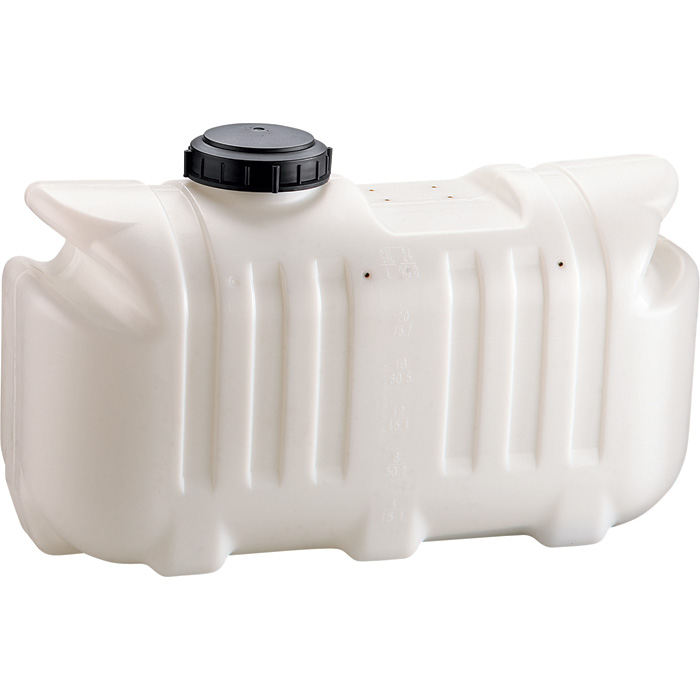
When I was building my home, I planned for my water tank under the kitchen counter in the corner of the "L". This is a space that is frequently difficult to access so why not put something in that space that does not need frequent access. One of the cheapest and strongest tanks I could find was a basic "spot sprayer" designed for garden use; mine is 26 gallons and approx. $60 with postage (from Northern Tool).
This tank has a mounting pad on top for a 12V pump. However it does not have an inlet for the pump siphon-a drill will open a hole and a piece of PVC (about 1/2" diameter) will work for the siphon. Make sure to vacuum out any drill debris before use as it will clog the pump. I purchased the flojet 2.9 gpm 50 psi water pump from amazon and mounted it atop my tank.
The left side of the pump with the inline filter goes to my PVC siphon tube in the tank and the right side goes to my plumbing lines. 

Below are a couple images showing the installation. The large diameter plastic hose is my water fill that hooks up to my exterior water fill panel.


The left hole is for filling the tank and the right side is for hooking up pressure water. The small round screen between the two fills is for venting the tank.

I have three plastic jugs, about 7 gallons each, that I use to bring water to my home. These are a bit to heavy to hold up while the water drains into the fill so I setup a 120V water pump outside my house to draw from the totes and pump into the tank. Because I live in a cold environment, I disconnect both hoses from the pump so no water is retained in the pump-freezing would destroy the pump and lead to a bad day.
My water tank services my kitchen sink, my bathroom sink and my shower. This is a labeled drawing of the rats nest of pipes that feed the various faucets.


Let me know any questions and I will try to help with better information. (Purchase of any of these items through our links will give us a few pennies to cover internet costs and allow us to continue providing additional content, thank you).


Welcome to MooseVilla and our blog


Welcome all friends, tiny house folks, wild and pet animal lovers and photographers. I have been a member of a few facebook groups involved with tiny houses and provide feedback to many questions. Some questions occur frequently and I will use this blog to provide more detailed information to these frequent questions.

If you have any needs or desires, please write me and I will attempt to meet these requests.  I have my own tiny house that I have constructed and love to help others with their journey to a more joyous life.
As you can see, I live in an area that is cold and that is my preference. For the past four years, I have lived in Upper Peninsula, Michigan very close to Lake Superior. However, at the end of May 2016, my house and I will be moving to NW Wyoming. I love to have a comfortable house; one that makes me happy to come home. I have designed my home to fit my needs and I do change things as needed. Here are a few interior pictures:


 I am passionate about wildlife and I am currently finishing my PhD studying moose ecology at Michigan Technological University. I love all animals but I am have a rabid love of moose. I have also been a professional wildlife photographers with extensive travels about North America and Siberia. Welcome to our blog.


Saturday, August 9, 2014

Continuation of tools discussion

When building your tiny home, you will need a workbench. This will be a place for mount your miter saw, table saw, or just to have a platform to work. Sure, you can try to mount your tools on the deck of the trailer; however, soon the trailer bed will be occupied with your home. You could try to work on the ground but your back will take a beating. I content that I am not lazy, I am a conservationist; I conserve my own personal energy.

You could also build a workbench but I prefer a mobile structure. This way I can move it inside the tiny house when I am working on the interior, up to the loft when working up there or outside for the siding and such. One of the best innovations to come out recently is the Keter worktable. Here is an image.
 Image copyright amazon.com


It folds down for easy storage and transport and it is very easy to setup. It is pretty steady and a good work surface. At about $70, it is not to expensive and will save wear and tear on your back. There are a couple youtube videos online, they will explain its use better than I.

I would also purchase a set of sawhorses. You will need sawhorses to cut long sheets of plywood or to paint your siding boards.

Tools for construction of a tiny house

Image downloaded from the internet at http://naturalpapa.com


I have read somewhere that one can build a tiny house with only 14 tools; it may indeed be possible but life will be much better with a bit more conveniences. How would one complete electrical work without a screwdriver? The image above shows four power tools, a miter saw, jig saw, circular saw and a drill. In the construction of a tiny house, these four power tools will certainly get a workout. I would add a couple extras; an impact driver, a small table saw and maybe a router. Of course getting an air compressor and pneumatic nailers will greatly simplify your life and ease the burden on your arms. It is possible to rent these tools but for the duration of time needed for most of these tools, it would be better to purchase and then sell upon completion.

I would use the impact driver for the thousands of screws and bolts that will need to be driven; I would use the table saw for cutting long angles across grain or cutting drip edges into the bottom of window sills and I would use the router for rounding over edges of wood for the ladder, edge of the tongue-and-groove boards on the loft and other areas. Andrew Morrison showed how to use a router to cut out window and door openings in his video series "Building a Tiny House"; this is really quick and easy. Sure, you can round over with a file but a router does such a beautiful job. You can buy the tools used on craigslist, use them for the construction, then sell them for approximately the same price at the end of construction.

Personally, I set my tool budget at $1500 with plans to sell the un-needed tools upon completion. I figure I can sell the power tools upon completion to recover some of my investment. As stated above, if you purchase the tools used and sell used, you could spend much less. So, here is the list of power tools and their costs I have obtained for my tiny house. The power tools occupy over half of my tool budget.

Craftsman sliding compound miter saw ($190)
19.2 volt drill and impact drill combo set ($110)
Refurbished Skil router ($49)
Porter Cable jig saw ($60)
Craftsman circular saw ($70)
Porter Cable air compressor ($110)
Husky brad and finish nailer set ($70)
Table saw ($200)

You can get a compound miter saw and table saw for $100 each but I wanted the extra capacity of the sliding compound miter and I wanted the slightly better quality of the more expensive table saw. I plan to build my own cabinets and interior furnishings. My past experience with building showed me that an increase in quality helps my end product. You can drive all your nails with a hammer but install tongue-and-groove interior siding is much easier with a finish nailer.

In my next blog post, I will discuss the "non-power" tools we can add to this list to make life a bit more comfortable.


Friday, August 8, 2014

The foundation

Tiny houses can be built on foundations or trailers with wheels. For the purposes of this blog, I will define a tiny house as less than 250 square feet; that is about the maximum amount of square footage that can be contained on a road-legal (without special permits) mobile tiny home. Typically, for this size home on wheels, car hauler trailers are used as a foundation.

There are two options for obtaining a car hauler trailer; purchase used or new. I have read numerous accounts of builders that purchased a trailer used but then spent days or weeks sanding, painting and modifying the used trailer for their tiny home. That is certainly an option and you might be able to save a few thousand dollars going the used route.

If you purchase new, you have a couple other options. You can purchase a ready-made commercial trailer, a tiny house trailer or have a trailer custom made for you. Commercial trailers are marketed in nearly every large city because they are used for construction, hauling, farming and other applications. With a fist-full of money, you can go in and purchase a trailer from the lot. Most likely, modifications will need to made this this trailer to adapt it for a tiny house. You could purchase a trailer constructed for a tiny home, such as a tumbleweed trailer or a tiny house builder's trailer. Both are good options for a semi-custom trailer but typically, they are more expensive and they are constructed to what these builders consider "custom". Plan to spend at least $500-1000 more for one of these trailers than you would spend if you ordered your own custom trailer. The third choice is to have a custom trailer constructed specifically for your use.

I admit, having a custom trailer constructed is time consuming but you will obtain a trailer to the specifications you choose. I chose to have my trailer custom built by Kaufman Trailers in North Carolina. Kaufman was very good to work with, they are experienced with custom trailers for tiny homes and they had an established delivery contractor that was much cheaper than the other manufacturers.

I ordered a custom Kaufman trailer the first week of August 2014 with the following options: 20 foot deck, 10,000 capacity, no dovetail, no wood boards on deck, crossbeams welded even with top deck, no ramps, no tie downs or other attachments on the side, and front trailer jack near front of tongue. Ordering from Kaufman saved me over $1200 if I had purchased a "tiny home trailer"; delivery of my trailer is scheduled for mid-September 2015. One option I was unable to get from Kaufman is "side extensions" that extend the trailer bed from 82" width to 96" width. Kaufman was able to do side extensions of 102". I will have side extensions added once the trailer arrives.
 My custom trailer will be similar to this without the dovetail (sloped rear deck), wood decking, tie downs or the front rail. Overall price of this custom trailer; less than $3000 and delivery to upper Michigan was only $700.


The beginning and a continuation of past

I have lived in small apartments, tents and sailboats. I have also lived in MacMansions. Living in a small space is more comfortable for me. This starts the adventure and creation of MooseVilla, my tiny house on wheels that will be my home and research facility. 

I am currently a second year PhD student at Michigan Technological University in Houghton, Michigan studying Moose Ecology. Once I complete my degree, my home and I will be located somewhere in the frozen north working and studying moose. I invite you all to follow the journey as we construct my home and research platform. Prior to returning to school, I was a self-employed laboratory scientist and a professional wildlife photographer. It was my work with wildlife that encouraged me to return to school to pursue my passion for moose. I am not young like most students but my passion has not died with my advancing age. I am currently 58 years old. 

Come with me as we study moose and build my home.


 Bull moose in Jasper, Alberta Canada; photograph copyright Moose Henderson